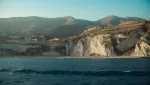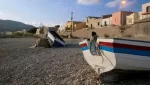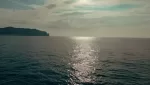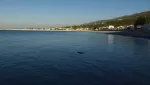
Almost everyone who goes out from Giardini Naxos by boat turns north. That is understandable: the Taormina cliffs, the sea caves and Isola Bella are all up that way, and they are the postcard. But the bay has two ends, and the southern one sees a fraction of the traffic.
Turn the other way and the coast changes character inside ten minutes. It goes low, dark and wide, and Etna stops being a shape on the horizon and becomes the thing you are running along the foot of.
What you see heading south from Giardini Naxos by boat
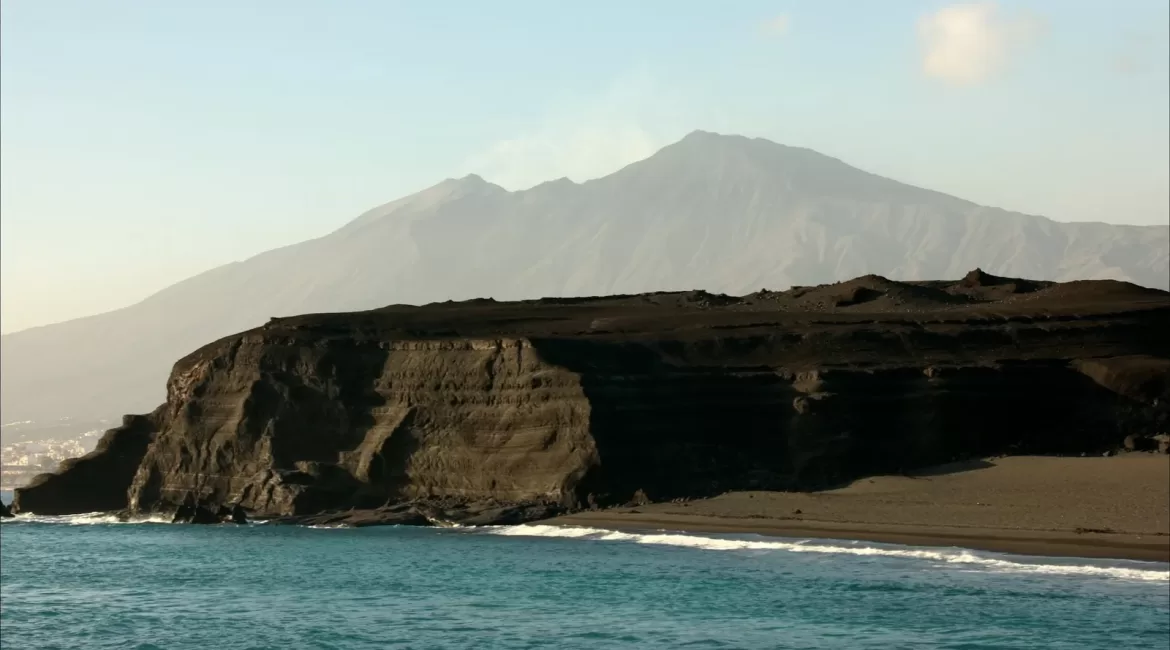
The first landmark is Capo Schisò, the flat black headland that closes the southern end of the bay. It is old lava — a flow that came down off Etna, reached the sea and cooled into the ledges and low platforms you see today. From the water you can read the whole story at a glance: no cliff, no drama, just black rock lying flat on a blue surface with prickly pear growing out of the cracks and a small lighthouse on the point.
Round the cape and the shoreline opens out. The beaches turn to dark grey sand and coarse pebble, the hills step back, and the plain that runs down from the volcano finally has room. This is where the Alcantara arrives — the river that comes out of the gorge inland and finishes here in a shallow, braided channel. On a still morning you can see the change in the water where it meets the sea: a paler band, a slight seam on the surface, and a noticeable drop in temperature if you swim through it.
Further on come Fiumefreddo and the long, empty run of coast towards Calatabiano and Marina di Cottone — citrus and eucalyptus behind the beach, a few low houses, and almost nobody on the water. It is not spectacular in the way the cliffs are spectacular. It is something else: open, agricultural, quiet, with the biggest volcano in Europe standing directly behind it.
Where the rock changes colour
The most interesting thing about this stretch is the join. The coast north of Giardini Naxos is pale — the limestone mass of Monte Tauro, the rock Taormina is built on, rising in sheer faces with caves eaten into the bottom of them. South of Capo Schisò the same coastline is black volcanic rock and dark sand.
The bay sits more or less on the seam between the two. You can leave a beach of grey volcanic grit, motor for twenty minutes and be looking up at a white cliff face. Very few coastlines change their material that fast, and from a boat — where you see the rock at water level, uninterrupted by roads or houses — it is obvious in a way it never is from the coast road.
When the southern coast is the better call
There is a practical reason to head this way, and it has nothing to do with scenery. Wind. This coast is exposed, and the two ends of the bay behave differently depending on what is blowing. When a northerly has been running for a day and the water under the Taormina cliffs is short and slappy, the sea south of the cape is often noticeably better behaved. A skipper who works here every day knows this before you have finished asking the question.
The light is the other reason. Late in the afternoon the sun drops behind Etna and the whole southern shoreline sits in soft, flat light with the volcano in silhouette above it. People who come here for the classic Taormina shot rarely think to turn around.
- You want somewhere calmer when the north side is choppy
- You have already done the cliffs and Isola Bella and want the other half
- You care more about Etna than about landmarks
- You want a swim stop with no other boat in sight
Worth saying plainly: this is a stretch to ask about rather than assume. Which direction makes sense on any given morning depends on the wind, the swell and how long you have out. That conversation is best had with the crew before you go — tell us what you are hoping for and we will tell you honestly which way the sea is pointing that day.
Can you swim on the coast south of Giardini Naxos?
Yes, and the water off the lava ledges is beautifully clear. It reads dark rather than turquoise, because the rock underneath is black instead of white, which throws people the first time. Near the river mouths expect a distinct cold layer and slightly cloudier water after rain inland. Shelter is thinner than in the coves up north, so a swim stop here depends more on the conditions of the day.
Is it better to go north or south from Giardini Naxos?
North, the first time. The caves, the cliffs and Isola Bella are genuinely worth the trip and they sit close enough together to cover comfortably, and the run north towards Letojanni carries on in the same spirit. Go south when you are coming back for a second day on the water, when the north side is uncomfortable, or when what you actually want is space, an empty anchorage and a very large volcano. Plenty of people end up preferring it.
Either way, the sea is the right vantage point. If you are staying in the bay and want to know what is on the other side of the cape, message the crew on WhatsApp and ask what the conditions look like for your dates.