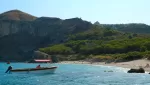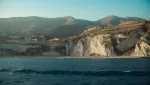
Spend an hour looking at the Taormina cliffs and sea caves from a boat and you stop seeing scenery and start seeing rock. That turns out to be more interesting, because this short stretch of coastline is doing something unusual: it changes its entire material within a few miles.
Pale stone under the town. Black stone south of the bay. Caves eaten into the bottom of one and not the other. None of it is decorative — it all has a reason, and the reasons are visible at water level.
The pale rock: Monte Tauro
Taormina is built on a limestone mass, Monte Tauro, that rises straight out of the sea and stops abruptly a few hundred metres up. That is the wall you look at from the water: cream and grey, layered, cut through with fractures, holding scrub and wild fig in every crack that will take a root.
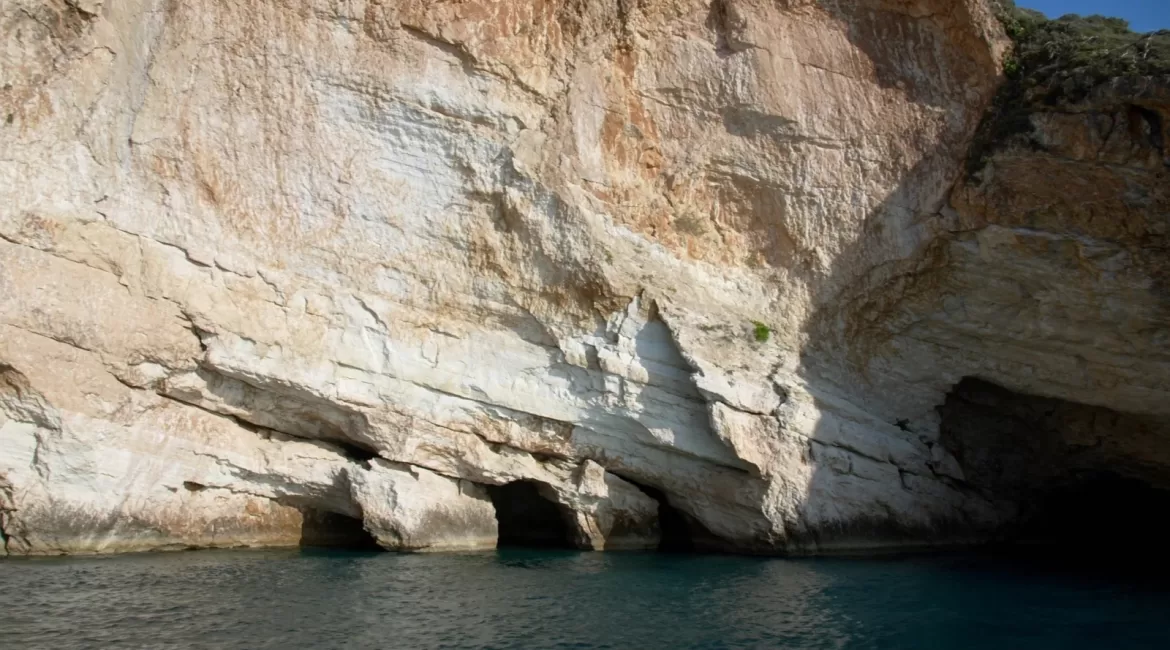
Look for the bedding — the horizontal lines running through the face. In places they are level, in places tilted or interrupted, because this rock has been folded and broken by the same forces that built the Peloritani mountains behind it. Where a fracture reaches the sea, the sea gets to work on it. That is the beginning of every cave on this coast.
How the Taormina cliffs and sea caves were carved
Waves are patient and extremely specific. They attack the weakest line available, which means the joints and softer seams in the limestone, and they attack it at one height: sea level. Water forced into a crack compresses the air ahead of it, the pressure works the crack wider, and over a long enough period you get a notch, then a hollow, then an opening you can take a small boat into.
This is why the caves under Taormina sit in a rough line rather than scattered up the cliff, and why the whole cliff base has a continuous undercut where the rock has been trimmed back. Sea level has not always been where it is now, either, so a few hollows sit slightly high and dry — old work, left behind.
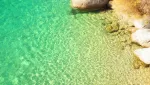
The Grotta Azzurra and the caves along this cliff are the showpieces. The blue is not paint or algae: light entering the water outside the cave loses its warm colours first, so what survives to reach the pale floor inside and bounce back up is the blue end of the spectrum. The cave glows because the rock underneath it is light-coloured. In a cave floored with dark stone, the same physics produces almost nothing.
The black rock to the south
Now look the other way. Below Giardini Naxos the coastline goes flat and dark, because a different mountain has been at work. Etna’s lava has reached the sea more than once along here, and the low black platform of Capo Schisò is the result: molten rock that ran down to the shore, met the water and stopped.
The contrast is remarkable when you see both within one trip. Sheer pale cliff with caves at its feet, and twenty minutes away a flat black ledge with no cliff at all, dark grey sand instead of white pebble, and water reading deep green-blue rather than turquoise because of what lies underneath it. Two coastlines, two entirely different origins, meeting in the same bay.
Isola Bella and the bar that built it
Isola Bella belongs to the pale side: a detached block of the same limestone, standing just off the shore. What connects it to the beach is not bedrock but a low bar of pebbles that the sea has piled up in the sheltered water behind the island.
That bar is temporary in the way geology counts time, and occasionally in the way people count it too. Storms rearrange it, currents move material along it, and the strip you can sometimes walk across is thinner or wider in different seasons. From the water it is the clearest lesson on the coast: the island is the rock, and the path to it is only borrowed.
A few things are worth watching for as you pass along the face:
- The notch at the waterline, running the length of the cliff
- Cave openings lining up along the same weak seams
- White salt staining above the splash zone, and where it stops
- The bedding lines, and where they tilt or break
- The colour of the water changing over pale rock and dark rock
Why is the Grotta Azzurra near Taormina blue?
Because of how light behaves in water. Sunlight passing through the sea into the cave loses red and yellow wavelengths quickly, leaving blue, which then reflects off the pale limestone floor and fills the chamber. It is strongest when the sun is high and the water is calm.
Is Isola Bella a real island?
Yes — it is a rock island, joined to the mainland only by a shifting pebble bar rather than by solid ground. Whether that bar is walkable depends on the sea and the season, which is a large part of why so many people end up looking at it from a boat instead.
If you want the coast explained at the speed it deserves, with the engine off under the cliff face, come out with us or send the crew a message on WhatsApp.