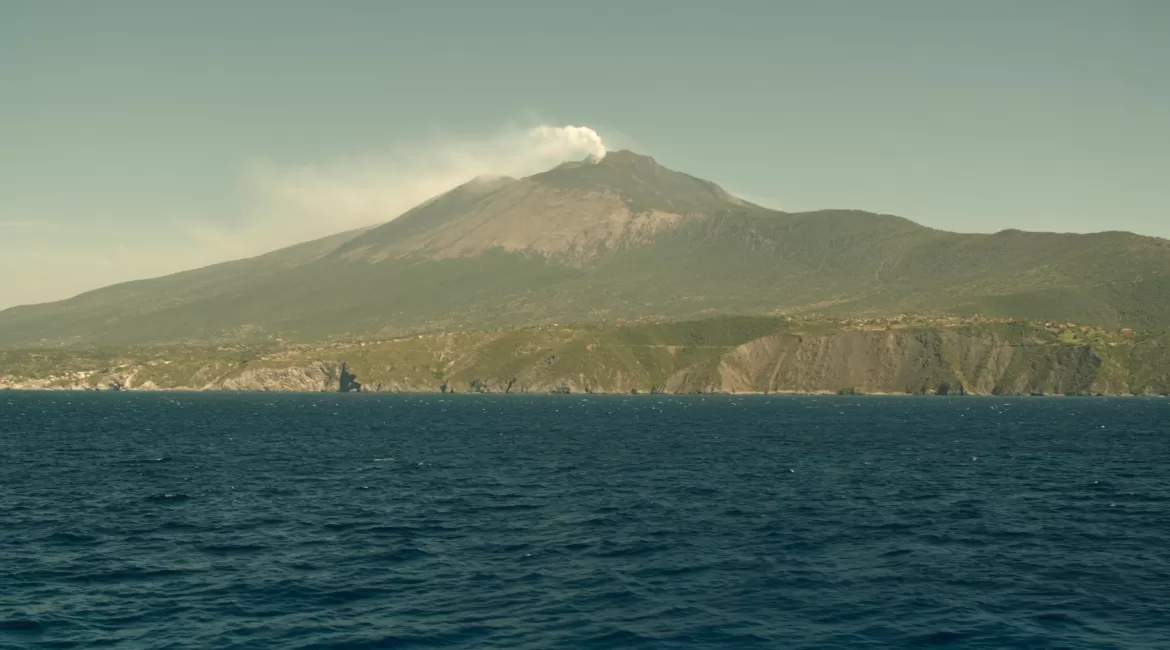
Seeing Etna from the sea off Taormina is not the same as seeing it from the coast road, and it is not the same as standing on it either. From the water you get the one thing neither of those offers: the whole volcano at once, base to summit, with nothing in front of it.
Sicilians call it simply a Muntagna — the mountain — as though there were no others worth naming. Once you have looked at it from a few kilometres offshore with the deck moving gently under you, the definite article makes sense.
Why the view is different from the water
Etna is enormous and it is close, and those two facts fight each other on land. From Taormina you see it in pieces, framed by buildings, cut off by the shoulder of the hill, usually with the lower slopes hidden. Drive along the coast and it appears and disappears behind every headland.
Push out to sea and the framing problem vanishes. The volcano sits at the head of the gulf, and from a boat you can see how it actually works as a landform: the wide skirt of old lava running down to the coast around Riposto and Acireale, the flank rising in long shallow steps, the summit cone with its permanent thread of vapour bending away in whatever wind is up there. On a clear day you also see how much of eastern Sicily is simply Etna’s foot.
The light, and when to catch it
Summer haze is the enemy. In the middle of a hot August day the mountain often softens into a grey silhouette, present but flat. The good moments are at the ends of the day.
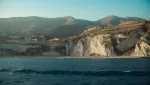
Early morning is the reliable one: the air is clearest before the heat builds, and the sun rising over the Ionian throws light straight onto the western flank, picking out the ravines. Late afternoon and evening are the beautiful one — the volcano goes from grey to lilac to a deep rose as the sun drops behind it, and because Taormina faces east you get the cliffs lighting up in the same frame. That combination of gold rock, dark blue water and a rose-coloured volcano is the reason people book a sunset tour and then talk about the volcano rather than the sunset.
In winter and spring the summit carries snow and the contrast is spectacular, but the water is a different proposition then. In late summer you are trading the snow for warm sea and long evenings.
What you are actually looking at
Etna is one of the most active volcanoes in the world and it is almost never entirely still. Most of the time the activity is undramatic from a distance — a steady plume, sometimes a puff of ash that drifts and dissipates. When there is a paroxysm the whole coast knows about it, and from the water it is genuinely extraordinary, though nobody can promise you one.
What you can count on is the scale and the geology. The dark grey-black sand on the beaches at Giardini Naxos is Etna, ground down and delivered to the coast. The lava headland at Capo Schisò, where the first Greek colonists landed, is Etna. The soil that produces the wine on the northern slopes and the lemons along the coast is Etna. It is not a backdrop to this coastline — it made it.
Getting the shot
- Shoot early or late. The middle of the day flattens it.
- Include something in the foreground — a headland, the bow, the coastline — or the volcano loses its scale entirely.
- A slightly longer lens compresses the mountain and the coast together and reads far more like what your eye sees than a wide-angle does.
- Bring a cloth. Salt spray on a lens is the most common way a good photograph goes wrong on a boat.
Can you see Etna from every boat trip?
You can see it from most of this coast when the air is clear, and the further south and further out you go the better the angle gets. Haze, cloud on the summit and the direction you are looking all make a difference on the day, so treat a perfect view as a gift rather than an itinerary item.
Is it better to go up Etna or see it from the sea?
They are two different experiences and neither replaces the other. Going up puts you in the black moonscape of the craters and gives you the summit’s own view over the island. From the sea you get the shape of the thing — which, oddly, you cannot see at all when you are standing on it. If you have time for both, do both.
When is the best time of year?
For clarity and snow on the cone, the cooler months. For the combination of good light, warm water and a comfortable evening on deck, late spring through early autumn — with sunrise and sunset doing most of the work.
If you want the version with the volcano turning pink over your shoulder, that is an evening trip. Message the crew on WhatsApp at +39 342 110 9242 or book through Taormina Boat Service, and keep an eye on the horizon on the way out.